

FORGED PIPES
The production of forged pipes represents the Forge Fedriga’s core business. Our company provides customers with a wide range of pipe sizes and materials unavailable from standard pipe manufacturers. We are a reference point in the pipe-making industry, aware of the quality of our parts that offer better mechanical and metallurgical characteristics and higher standards than pipe mill productions (rolling/extrusion/reciprocating rolling).
H2 What are forged pipes, and what are their main applications?
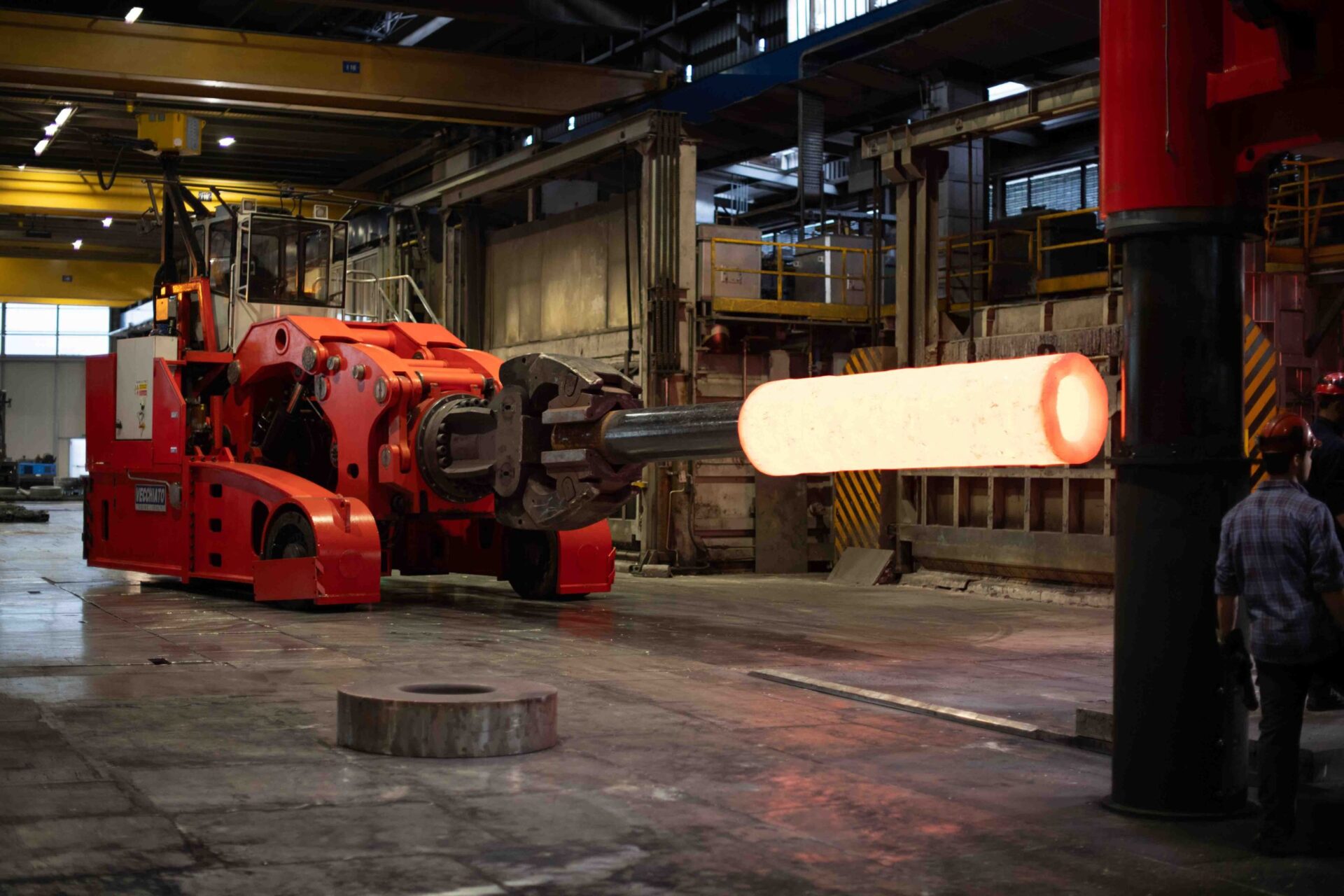
Forged pipes are manufactured using an industrial production process involving plastic deformation of metal pieces in different sections. The pieces are brought to a very high temperature and processed in a forging press. The result is a forged pipe: the original piece has changed shape without risking breakage.
Forged pipes have a wide variety of applications, partly because of their versatility in industrial and mechanical engineering.
Mechanical, hydraulic, and pneumatic engineering applications are just some possible applications for forged pipes. In fact, they are also used as fittings for the chemical, boiler-making, food, pharmaceutical, and medical industries. High-precision forged pipes can be used for food-making machinery, measuring instruments, and precision engineering.
Forged pipes are also needed in the agricultural and paper processing industries. Mining companies, nuclear power plants, and refineries are other areas where there is typically a need for forged pipes, which also ensure the highest quality standards because they are made in accordance with specific industry standards. Forged pipes resist wear and tear and time, unaffected by external agents such as weather or chemical agents.
H2 How tube forging works
Forged pipes are obtained by the hot drawing of metal alloys, so the high temperature brings the semi-finished product into a more plastic condition. Hot forging provides multiple advantages and allows working on steels of various types and thicknesses, from austenitic to martensitic steels to nickel base alloys.
In open-die forging, two anvils (mallets) deform the material and obtain the desired parts. As mentioned, forging helps improve the material’s mechanical properties and structure. Together with rolling and drawing, it can make a material anisotropic since it promotes a preferential grain orientation. The advantage of forging over other types of processing is isotropy.
Isotropy refers to the invariance of physical properties as a function of direction. In the case of rolling, a pair of rotating rollers exerts a compression. The length increases, and the cross-sectional area of the material is reduced so that pipes are obtained. On the other hand, the isotropy of forging leads to a significant difference between the mechanical properties of forged pipes compared to rolled pipes. Forged pipes have significantly higher quality, withstanding more extreme conditions and extended periods.
H2: Forge Fedriga’s solutions in the field of forged pipes
Forge Fedriga is a leading manufacturer of forged pipes. Among other things, our plant can count on a new heat treatment island for pipes up to 6.5 meters long. Our production range starts from a minimum of 210 to a maximum of 1200 millimeters for the outer diameter of forged pipes and from a minimum of 190 to a maximum of 1050 millimeters for the inner diameter. The maximum weight and length of forged pipes that can be manufactured vary depending on the type of material and diameter. However, generally, it is possible to reach up to 15 tons and 6 1/2 meters in length.
To obtain forged pipes of excellence such as those manufactured by Forge Fedriga, one of the most important steps is heat treatment. It is essential to ensure the structural uniformity of the forged pipe and its mechanical properties, which must meet the customer’s specifications and the quality standard requirements. Forge Fedriga can rely on as many as five furnaces for heat treatment, two cooling tanks with temperature monitoring, and an automated heat treatment plant that includes two furnaces and a cooling tank with integrated load handling.
Would you like to learn more about Forge Fedriga’s solutions in the forged pipe sector? Ask us for a personalized quote and learn more about the features of our products. On our website, you also have the opportunity to check all the materials we produce.
Impostazioni di accessibilità
Chiudi questo pannelloAumenta il contrasto tra gli elementi in primo piano e gli sfondi
Aumenta le dimensioni del cursore
Attiva la sottolineatura automatica di tutti i collegamenti
Aumenta a piacimento la dimensione dei testi
Seleziona una porzione di testo e leggilo
Attiva il carattere specifico che facilita la lettura a chi soffre di dislessia
